



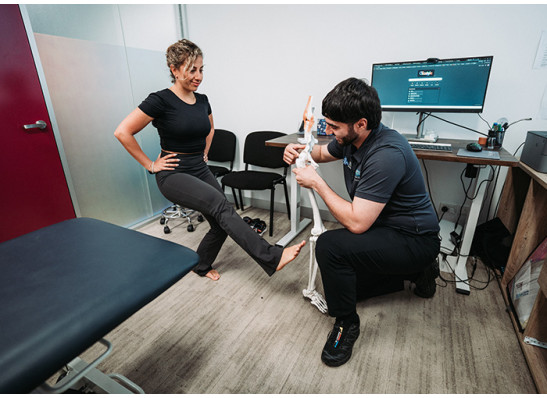
Pain low in your back or deep in one buttock can be confusing. Is it your spine? Your sacroiliac joint (SIJ)? Your hip? You may have heard different answers from friends, websites or past practitioners.
No single symptom or test can tell these sources apart on its own. SIJ pain has no unique location or feature, and it can feel very similar to pain from other structures in the lower back.1
A physiotherapy assessment can narrow the possibilities. Your physio combines your history, a movement examination, nerve checks and specific SIJ tests to form a working diagnosis and a plan, then reviews it as you progress.
At Head2Toe Physiotherapy & Podiatry in Brunswick, Moonee Ponds and Kew, this is how we approach lower back and buttock pain.
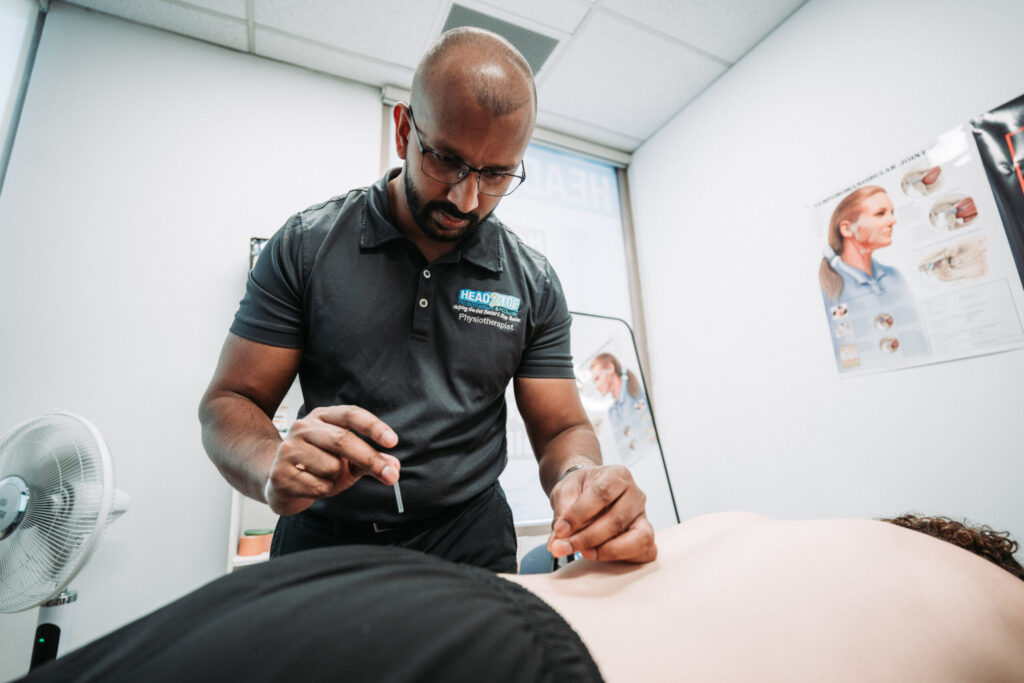
SIJ pain at a glance: The SIJ is estimated to be the main source of pain in roughly 15-30% of people with ongoing pain mainly below the lowest lumbar area.2 SIJ pain can feel very similar to pain from the lower back or hip, so no single symptom or test can confirm it. Your physio checks your spine first, then uses a small cluster of SIJ tests that shifts the odds up or down. Pelvic pain that starts during pregnancy or after birth is a condition of its own, with its own tests. Most people do not need a scan, and treatment centres on education, activity and exercise.
Why do SIJ pain and lower back pain feel so similar?
The SIJ, lower spine, nerves and hip share overlapping nerve supply, so the pain they cause often overlaps too. People with confirmed SIJ pain most often feel it in the buttock and lower back, but it can also spread to the groin or down the leg.3
SIJ pain can spread into the leg and feel like sciatica, without necessarily being caused by a compressed nerve in the lower back.4 Because pain patterns from the SIJ and lower spine overlap, your physio will check your spine first to help rule it out.5
Some features make one source more or less likely. Your physio may look into the clues below as part of your assessment.
| Symptom or finding | What your physio might investigate |
|---|---|
| Pain mainly below the lowest lumbar level, with little central back pain | Whether SIJ tests reproduce your familiar pain2,6 |
| Groin pain as well as buttock pain | The SIJ, but also the hip joint2 |
| Pain spreading below the knee | Nerve irritation versus pain referred from the SIJ or spine4 |
| Pain that moves towards the centre of your back with repeated movements (centralisation) | A disc-related source becomes more likely6 |
| Pain after a fall onto the buttocks | The SIJ or its ligaments as one possible source2,4 |
| Pain that began during pregnancy or after giving birth, including pain at the front over the pubic bone | Pregnancy-related pelvic girdle pain, which can involve one or both SIJs and the pubic symphysis7 |
| Morning stiffness over 30 minutes, night pain, or pain that improves with activity rather than rest | Possible inflammatory back pain, which may need GP review2 |
How does a physio assess the difference?
Your physio looks at several pieces of information, each nudging the likelihood up or down.

1. Your history
Your physio will ask where the pain is, how it started, what eases or aggravates it, and how it affects your day. Useful details include a fall onto the buttocks, pregnancy, previous spinal surgery or pain at night.2,4 They will also screen for symptoms that need medical review.8
2. Back movement first, then the hip
Because the spine can refer pain to the SIJ region, it is assessed before the SIJ.5 Your physio will ask you to repeat movements, such as bending backwards or forwards several times, and watch how your pain responds. If your pain centralises (moves from the buttock or leg towards the middle of your back), a disc source becomes more likely.6 The SIJ is only tested once the lumbar spine has been fully assessed, as SIJ tests done too early can give false positives.9
Pain location also shifts the odds. SIJ pain at or above the level of L5 is uncommon, and midline back pain makes the SIJ less likely to be the source.6,9 The hip is also examined, as hip problems can cause buttock and groin pain.1,2
3. Nerve checks when needed
If pain travels into your leg and nerve involvement is suspected, a focused neurological examination is recommended.8 This may include strength, sensation, reflexes and a straight leg raise. Leg weakness and a positive straight leg raise point more towards an irritated nerve root than towards the SIJ.4
4. SIJ pain-provocation tests
These tests load the SIJ in different directions. The four with the best evidence are distraction, thigh thrust, compression and sacral thrust.1 A test counts only if it reproduces your familiar pain.
The numbers behind the tests. In a key study, two positive tests out of these four picked up 88% of people whose SIJ pain was confirmed by an anaesthetic injection into the joint, and correctly cleared 78% of those whose pain came from elsewhere.1 Three or more positives out of six tests performed similarly, and adding Gaenslen’s test did not improve accuracy.1
Why the order matters. Thigh thrust is the most sensitive test and distraction the most specific, so these come first. If both reproduce your pain, testing stops. If one or neither does, compression is added, then sacral thrust, stopping as soon as two are positive. Fewer than two positives makes SIJ pain unlikely.1 This order avoids unnecessary painful tests.1 The cluster is also only interpreted once the spine has been tested, because accuracy improves when it is used in people whose pain does not centralise.1,9
5. Load transfer: the active straight leg raise
Lying on your back, you lift one straight leg about 20 cm off the bed and rate how hard it feels on each side, from 0 (not difficult at all) to 5 (unable).10 The active straight leg raise (ASLR) checks how well load passes between your trunk and legs through the pelvis.10
Your physio may then repeat the lift while compressing your pelvis by hand or with a belt. A pelvic belt has been shown to make the lift easier.7 A lift that feels heavy and improves with compression suggests reduced “force closure”: the muscles around the joint are not compressing it enough to control load.11 If the lift feels normal but compression increases your pain, the problem is more likely too much compression from over-active muscles.11 These two patterns are managed differently, as described below.
Putting it together
Your physio combines these findings into a working diagnosis, explains it and sets clear points to review. If you’re not improving as expected, the diagnosis is revisited.
In some cases, a specialist may use an image-guided anaesthetic injection into the joint. This can help clarify whether pain is coming from inside the joint, although these injections can also give false results.2
Pelvic pain in pregnancy and after birth
Pregnancy-related pelvic girdle pain (PGP) is a condition of its own and about 1 in 5 pregnant women have it.7
Where is the pain?
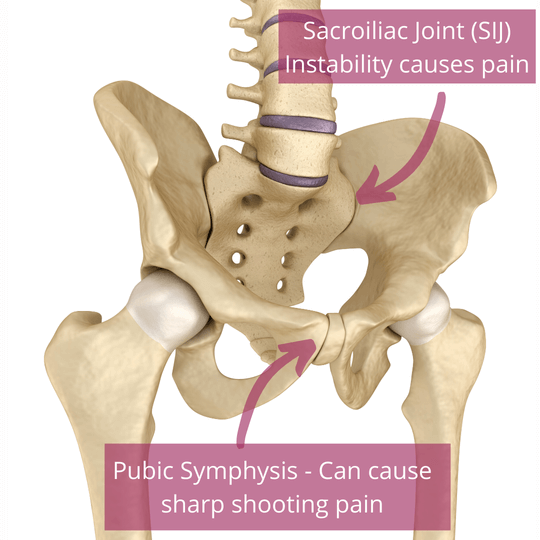
PGP is felt between the back of the pelvic rim (posterior iliac crest) and the buttock crease, mostly around the SIJs. It may spread into the back of the thigh, and can occur with, or separately from, pain at the pubic symphysis at the front of the pelvis. Standing, walking and sitting tolerance are usually reduced.7 The diagnosis is made once lumbar causes have been ruled out and the pain is reproduced by specific tests.7
Subgroups
Pain can involve one or both SIJs, the pubic symphysis, or all three pelvic joints. A large Danish study described four subgroups:12
| Subgroup | Where the pain is | Share of pregnant women12 |
|---|---|---|
| Pelvic girdle syndrome | Both SIJs and the symphysis | 6.0% |
| Double-sided SIJ syndrome | Both SIJs | 6.3% |
| One-sided SIJ syndrome | One SIJ | 5.5% |
| Symphysiolysis | Symphysis only | 2.3% |
SIJ pain in pregnancy is tested with the thigh thrust, Patrick’s FABER and Gaenslen’s tests, pressure on the long dorsal ligament, and the ASLR.7
The guidelines advise against tests that try to feel SIJ movement, and against X-ray, CT and diagnostic injections for PGP. MRI is reserved for suspected systemic conditions or other red flags.7
How is symphysis pain told apart?
Symphysis pain sits at the front, over the pubic bone.7 Pain where the inner-thigh (adductor) muscles attach nearby can be mistaken for it.12 It is identified when pressing directly on the symphysis, or the modified Trendelenburg test (standing on one leg with the other hip and knee bent to 90 degrees), reproduces pain at the front.7 Hip tests can also provoke symphysis pain, so the result is judged by where the pain is felt, and the hip itself is checked as another cause of groin pain.7,11
“Unstable” or over-compressed?
Reduced force closure is often linked to pelvic pain after birth: the ASLR feels heavy and eases with compression. It is sometimes called an “unstable” pelvis, but the SIJs are inherently stable and the label can add to worry. Others over-brace (excessive force closure): the lift feels normal, but compression aggravates their pain. In this proposed model, based largely on clinical observation, the two are managed in opposite ways.11
Do pelvic belts help?
A belt may reduce movement (laxity) at the SIJ, and has been shown to make the ASLR easier.7 Evidence that belts improve symptoms is weaker. The European guidelines found no controlled trials of a belt on its own (one small pilot study in pregnancy reported less pain) and suggest a belt only as a short-term trial for relief.7 An international guideline found low-certainty evidence that belts help some people with SIJ pain.2
In practice, a belt is a trial for symptom relief alongside exercise. It suits the reduced force closure pattern and may aggravate pain in people who already over-compress.7,11
Exercise

European guidelines recommend tailored exercise during pregnancy, and a tailored program combining several treatments thereafter.7 In a trial of women with PGP after pregnancy, a 20-week program focused on specific stabilising exercises reduced pain and disability more than physiotherapy without them, both at the end of treatment and one year after birth.7
Do I need an X-ray or MRI?
Usually not. Australian and UK guidelines advise against routine imaging for low back pain. Scans are reserved for suspected serious conditions, or when the result is likely to change care.8,13
Scans also have real limits for SIJ pain. CT and MRI cannot reliably identify the SIJ as the source of pain.2 They also often show age-related changes, such as disc bulges, that are common in people without pain.8
Imaging does help in specific situations. MRI is the reference test for joint inflammation in conditions such as axial spondyloarthritis.2 It may also be needed if a fracture, infection or significant nerve compression is suspected. Your physio will refer you to your GP if a scan is warranted.
When should I seek medical help?
Most lower back and buttock pain is not caused by serious disease. A small number of symptoms, however, need prompt medical care.8
Seek medical attention immediately (call 000 or go to an emergency department) if you have:
- New difficulty passing urine, or loss of bladder or bowel control
- Numbness around the genitals, buttocks or inner thighs
- Rapidly worsening leg weakness or numbness
See your GP promptly if you have:
- New back pain with a history of cancer
- Unremitting pain, particularly at night
How can physiotherapy help?
Whether your pain comes from the SIJ, the spine or both, the foundations of treatment are similar. Your plan is then tailored to your goals and daily demands.
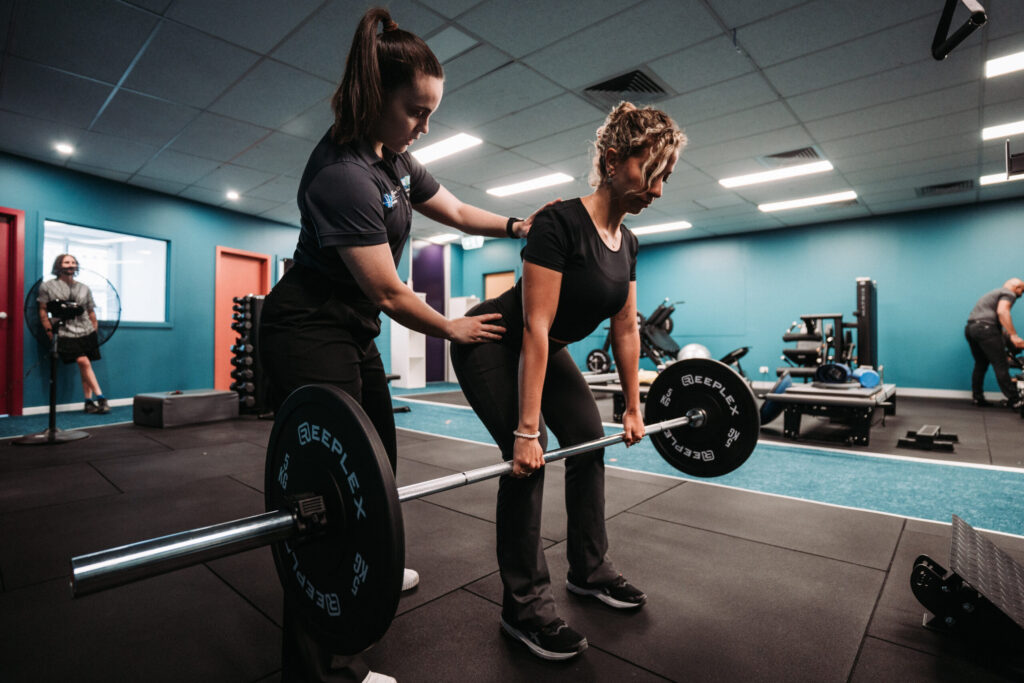
Education. Understanding what is likely driving your pain helps reduce worry and guides decisions about activity. Sleep, stress, work and general health can also influence back pain, so they are part of the conversation too.8
An activity plan. Your physio will help you adjust activities that aggravate your pain, stay active and gradually build back up.
Individualised exercise. Moderate-quality evidence shows exercise reduces pain in persistent low back pain.14 Evidence specific to the SIJ is indirect, but also supports physiotherapy and structured exercise.2
Exercise can be described as targeting “local” or “global” muscles. Local muscles attach directly to the lumbar vertebrae and control individual segments: the lumbar multifidus, the small interspinal and intertransverse muscles, the lumbar part of the erector spinae and the part of quadratus lumborum that attaches to the vertebrae.15 Transversus abdominis and the pelvic floor are usually counted as local too.11 Global muscles run between the rib cage and pelvis, transfer load and move the trunk: rectus abdominis, the external and internal obliques, the thoracic part of the erector spinae and the outer part of quadratus lumborum.15
Does specific stabilisation beat general exercise? For persistent low back pain, a Cochrane review could not recommend one type of exercise over another. It concluded that the most effective type of exercise is not yet confirmed, and found limited evidence that any one type works better than others.14 Pelvic girdle pain after pregnancy is the exception, where a trial favoured specific stabilising exercises.7 For people who already over-brace, stabilisation drills can make things worse.11 Your program is chosen to suit your pain pattern, preferences and goals.11,14
Hands-on treatment as an adjunct. For SIJ pain, manual therapy may improve day-to-day function.16 In most of the trials, it was added to an exercise program rather than replacing it.16
A pelvic belt, in selected cases. If your pain eases when your pelvis is compressed, a belt can be trialled for short-term relief. It supports an exercise program rather than replacing it.7,11
Reassessment. Recovery varies, so there is no fixed timeline. If progress stalls, your physio will revisit the diagnosis and may discuss referral to your GP or a specialist where appropriate.
Frequently asked questions
Can SIJ pain travel down my leg?
Yes. SIJ pain can spread into the thigh and below the knee, and can mimic sciatica.3,4 This is why nerve checks matter when leg pain is present.
Can I tell the difference myself?
Not reliably. Pain location overlaps between the SIJ, spine and hip,1,4 and even clinical tests only shift the odds.17 An assessment is the best place to start.
Is pelvic pain in pregnancy the same as SIJ pain?
Not exactly. Pregnancy-related pelvic girdle pain can involve one or both SIJs, the pubic symphysis, or all three joints, and each is checked with its own tests.7,12
Should I wear an SIJ or pelvic belt?
It may be worth a trial if your pain eases when your pelvis is compressed. The evidence is mixed, so a belt is used alongside exercise, not instead of it.7,11
Does my pelvis need realigning?
Probably not. Tests that try to feel whether the SIJ is “stuck” give inconsistent results between examiners, and no study has tested whether they are accurate.18 Studies using valid measurement tools have not found the SIJ shifting “out” of position.11 Treatment focuses on easing pain and restoring movement, strength and confidence instead.
SIJ and lower back pain physio in Brunswick, Moonee Ponds and Kew
If lower back or buttock pain is affecting your sleep, work or exercise, an assessment can help you understand what is likely going on and what to do next. Our physiotherapists will explain your findings and build a plan around your goals.
Book an appointment at our Brunswick, Moonee Ponds or Kew clinic. Book online, call 03 9326 0168 or email info@head2toe.com.au.
References
- Laslett M, Aprill CN, McDonald B, Young SB. Diagnosis of sacroiliac joint pain: validity of individual provocation tests and composites of tests. Man Ther. 2005;10(3):207-218. https://doi.org/10.1016/j.math.2005.01.003
- McCormick ZL, Hurley RW, Anitescu M, Bhaskar A, Bhatia A, Cassidy RC, et al. Consensus practice guidelines on sacroiliac joint complex pain from a multispecialty, international working group. Pain Med. 2025;26(12):817-917. https://doi.org/10.1093/pm/pnaf129
- Slipman CW, Jackson HB, Lipetz JS, Chan KT, Lenrow D, Vresilovic EJ. Sacroiliac joint pain referral zones. Arch Phys Med Rehabil. 2000;81(3):334-338. https://doi.org/10.1016/S0003-9993(00)90080-7
- Visser LH, Nijssen PGN, Tijssen CC, van Middendorp JJ, Schieving J. Sciatica-like symptoms and the sacroiliac joint: clinical features and differential diagnosis. Eur Spine J. 2013;22(7):1657-1664. https://doi.org/10.1007/s00586-013-2660-5
- Schumacher MR, Kovash DT, Forkin KT, Bylund DB. Screening of the thoracolumbar spine is almost completely absent in trials evaluating conservative management for sacroiliac joint pain: a systematic review of 43 randomized controlled trials. J Man Manip Ther. 2026;34(2):118-127. https://doi.org/10.1080/10669817.2025.2539783
- Han CS, Hancock MJ, Sharma S, Sharma S, Harris IA, Cohen SP, et al. Low back pain of disc, sacroiliac joint, or facet joint origin: a diagnostic accuracy systematic review. EClinicalMedicine. 2023;59:101960. https://doi.org/10.1016/j.eclinm.2023.101960
- Vleeming A, Albert HB, Östgaard HC, Sturesson B, Stuge B. European guidelines for the diagnosis and treatment of pelvic girdle pain. Eur Spine J. 2008;17(6):794-819. https://doi.org/10.1007/s00586-008-0602-4
- Australian Commission on Safety and Quality in Health Care. Low back pain clinical care standard. Sydney: ACSQHC; 2022. Available from: safetyandquality.gov.au
- Horton SJ, Franz A. Mechanical Diagnosis and Therapy approach to assessment and treatment of derangement of the sacro-iliac joint. Man Ther. 2007;12(2):126-132. https://doi.org/10.1016/j.math.2006.06.001
- Mens JMA, Vleeming A, Snijders CJ, Koes BW, Stam HJ. Reliability and validity of the active straight leg raise test in posterior pelvic pain since pregnancy. Spine (Phila Pa 1976). 2001;26(10):1167-1171. https://doi.org/10.1097/00007632-200105150-00015
- O’Sullivan PB, Beales DJ. Diagnosis and classification of pelvic girdle pain disorders, Part 1: a mechanism based approach within a biopsychosocial framework. Man Ther. 2007;12(2):86-97. https://doi.org/10.1016/j.math.2007.02.001
- Albert HB, Godskesen M, Westergaard JG. Incidence of four syndromes of pregnancy-related pelvic joint pain. Spine (Phila Pa 1976). 2002;27(24):2831-2834. https://doi.org/10.1097/00007632-200212150-00020
- National Institute for Health and Care Excellence. Low back pain and sciatica in over 16s: assessment and management (NICE guideline NG59). London: NICE; 2016. Available from: nice.org.uk/guidance/ng59
- Hayden JA, Ellis J, Ogilvie R, Malmivaara A, van Tulder MW. Exercise therapy for chronic low back pain. Cochrane Database Syst Rev. 2021;9(9):CD009790. https://doi.org/10.1002/14651858.CD009790.pub2
- Bergmark A. Stability of the lumbar spine: a study in mechanical engineering. Acta Orthop Scand Suppl. 1989;230:1-54. https://doi.org/10.3109/17453678909154177
- Trager RJ, Baumann AN, Rogers H, Tidd J, Orellana K, Preston G, et al. Efficacy of manual therapy for sacroiliac joint pain syndrome: a systematic review and meta-analysis of randomized controlled trials. J Man Manip Ther. 2024;32(6):561-572. https://doi.org/10.1080/10669817.2024.2316420
- Saueressig T, Owen PJ, Diemer F, Zebisch J, Belavy DL. Diagnostic accuracy of clusters of pain provocation tests for detecting sacroiliac joint pain: systematic review with meta-analysis. J Orthop Sports Phys Ther. 2021;51(9):422-431. https://doi.org/10.2519/jospt.2021.10469
- Ribeiro RP, Guerrero FG, Camargo EN, Beraldo LM, Candotti CT. Validity and reliability of palpatory clinical tests of sacroiliac joint mobility: a systematic review and meta-analysis. J Manipulative Physiol Ther. 2021;44(4):307-318. https://doi.org/10.1016/j.jmpt.2021.01.001







 42 Pascoe Vale Road, Moonee Ponds 3039